Perplexity: Building the Answer Engine Of The Future

Introduction
As Google faces the classic innovator's dilemma with its iconic 10 blue links, increasingly compromised by SEM and SEO strategies that prioritize ad revenue, Perplexity AI has emerged as a trailblazer in AI-native search. Their approach is predicated on an elegantly structured summary of the most relevant information pulled from a crawl of the web (with citations back to sources). They’ve embedded pro features that allow users to tailor the summaries to their specific preferences. In exposing the underpinnings of their engine via the Perplexity API, they’ve built a flourishing B2B business. Ultimately, they’ve established themselves as the vanguard of a new era in search engines, providing the most accurate, relevant answers to any query.
While this model has legs for years to come, we explore the surface area of opportunity for perplexity in building the answer engine of the future.
Perplexity’s Future: A simple framework.
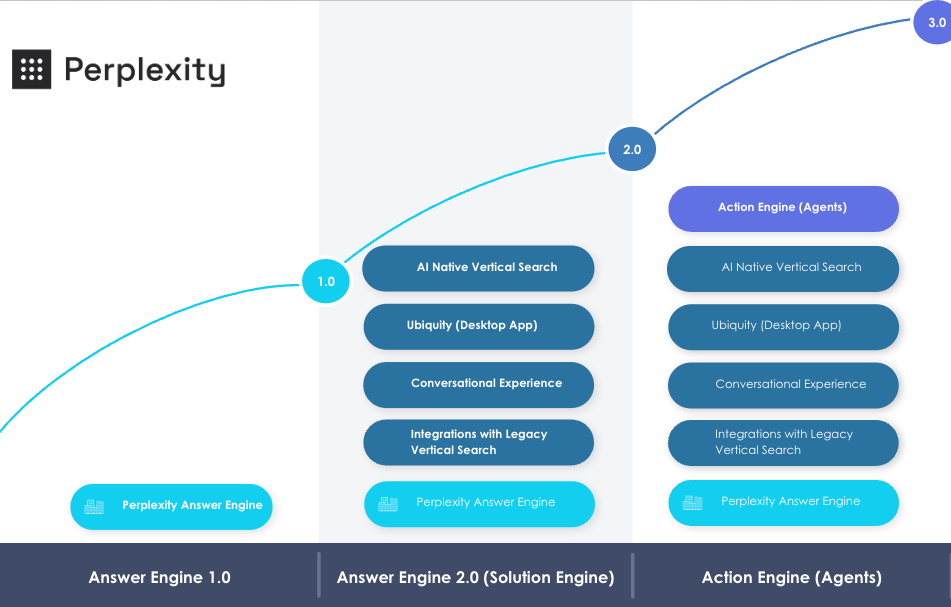
Though Perplexity AI has laid an impressive foundation with its Answer Engine, there are myriad opportunities to elevate the user experience and drive more constructive outputs that don’t just answer, but solve the query with the most optimal resolution.
Building the best answer engine
Let’s start with a fundamental understanding of what users are trying to achieve. The notion of an answer engine is vague. People have touted Google as an answer engine for decades — whether they surfaced the 10 blue links, displayed 0-click results or even as they experiment with generative AI search. Each of these experiences is fundamentally different and has a different fidelity of output. This begs the question — how do we define what defines the best answer engine? There’s a very simple answer that is important to spell out as the north star.
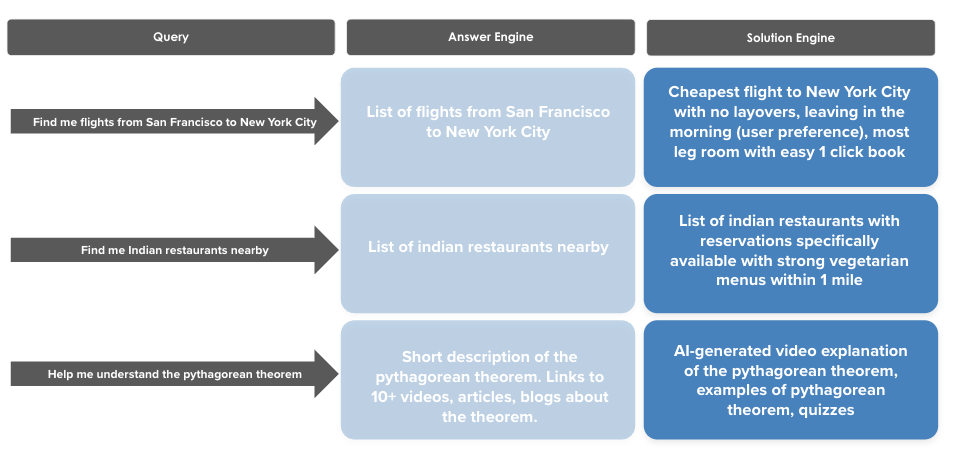
We define the best answer engine as one that surfaces not just an “answer”, but the optimal solution to a query, catered to users specific preferences.
This entails: (i) most recent, accurate information, (ii) ) highest relevancy of results for the query and for the users preferences (iii) fast speed of output
Let’s take a flight search scenario: while the "answer" to a query like "find me flights from San Francisco to New York City" might be a list of 50 available options, the optimal solution would be the most cost-effective flight that aligns with the user's specific criteria (e.g. legroom, stops, flight duration, cabin, points vs cash). Traditional search engines suffer from the tradeoff of (i) displaying an overabundance of options to maximize CPMs vs (ii) a focused solution driving conversions.
Similarly, when searching for restaurants, users aren’t only looking for an inundating list of options across 5 blogs, Yelp, Google Maps, but often a curated recommendation for a restaurant that meets their location, availability, and preference parameters. Vertical search engines have done a great job at giving users pre-canned filtering options and more relevant results, but it still involves many clicks, often times repeating the same information per query and combing through multiple engines to find what a user is looking for.
In researching a topic, the ideal solution for a user may extend beyond a simple answer to encompass supporting evidence, cited sources, diverse perspectives, and relevant follow-up information. Perplexity has started to build towards this with their follow-up and pro toggles, but there is ample room to build one level deeper.
It’s integral to build an engine that doesn’t just answer, but provides the optimal solution for the query. So how do we get to a more predictable and fruitful way of getting to the solution for any query a user asks?
Vertical Search
Over the past 15 years, we've witnessed a rampant unbundling of Google, with the rise of specialized vertical search engines like Zillow for real estate, ResearchGate for academic research, and SkyScanner for flights.
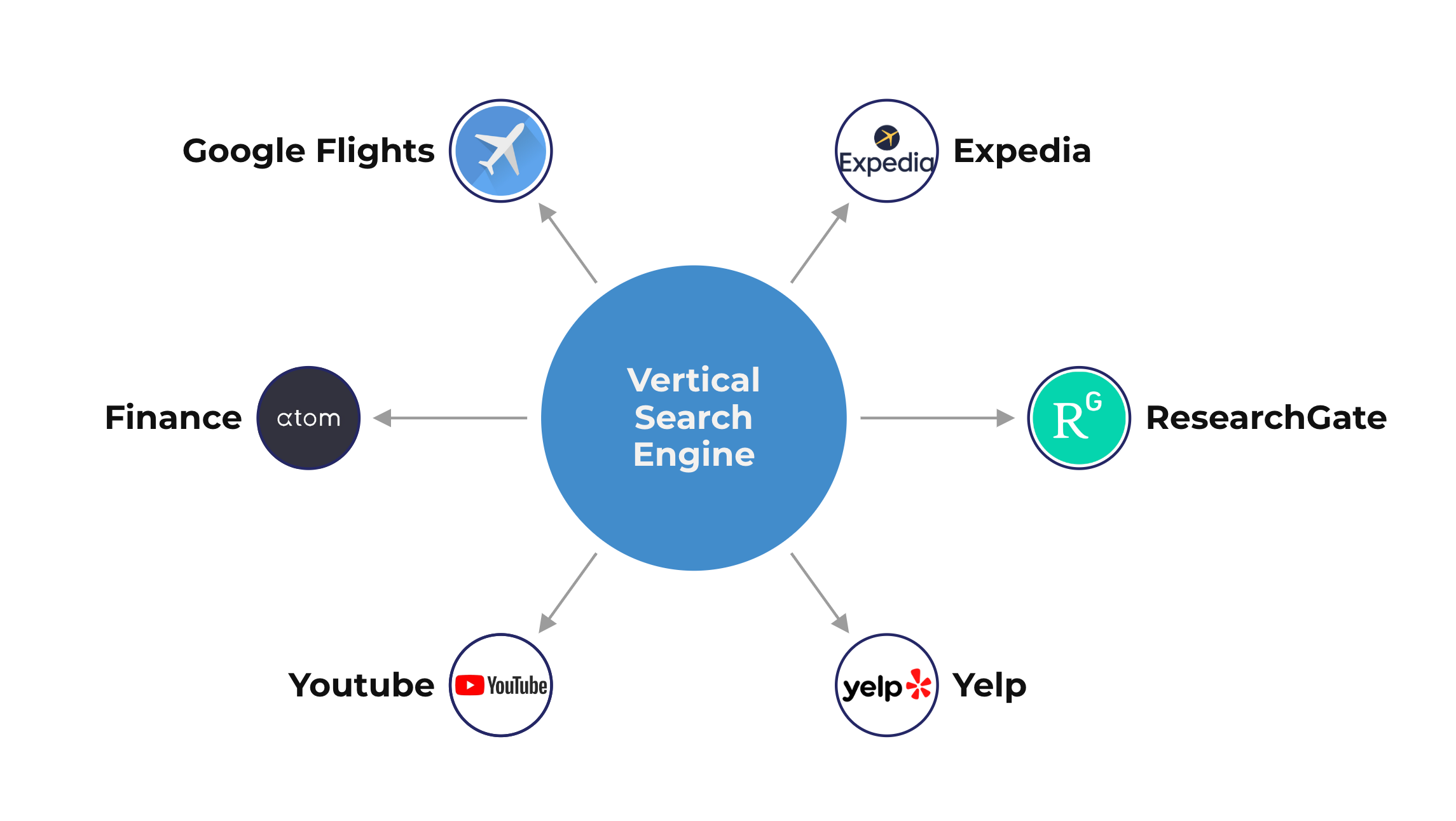
These platforms help users drill down into specific niches, but they often suffer from the following:
Fragmentation: Often times, users are using multiple vertical search engines that they need to sort through to find the most pertinent information — there’s no seamless mechanism to do it at aggregated level. In order to plan an itinerary with the best flight, points deal, hotel, restaurants and things to do, one might look across Expedia, OpenTable, Points.me, Google Flights, etc. When looking for rentals, one might go to Craigslist, look at Apartments.com, StreetEasy, Leasebreak, Facebook Groups and Zillow and then organize all the information to get the optimal result. In fact, users often will look across these and create a separate document or spreadsheet to be able to compare and aggregate results In each of these cases, users have to use multiple vertical search providers to get the best search result.
Walled Garden Verticalization: Often times, vertical search engines will try to relegate users to the specific boundaries of products and services that benefit the platform most. When making a purchase decision, a user wants results not just from Amazon’s catalog but from Facebook Marketplace, eBay, and other shopping sites in order to make an informed decision. If a user is looking to book a ride, they should be able to compare all options, from Uber to Lyft to a taxi to public transit to a bike. In fact, while Uber touts building their vertical search engine with options across multiple transportation mechanisms (public transit, bike, uber), all promos, incentives and placements are catered towards the main ride hailing service.
AI-Native Experiences: Lastly, none of these engines have been built with an AI-native lens — there is an enormous opportunity to up level the search experience. Let’s take the travel example above. A user would have to look at Expedia, Google Flights, Airbnb, TripAdvisor, OpenTable, etc to find the optimal itinerary. They may create a spreadsheet of all the options or go to Google Maps intermittently to see how far each place is from the other. What if the user had an AI travel agent that they could speak to which could aggregate the results from multiple engines, extract out the most relevant output and share that with them? That could understand the context of who the user is, their preferences, and provide an itinerary with one click booking based on their profile? One could even stretch the thinking further, wherein the tool could generate a map view and table with the results of all of the options. The optimal solution in this example is a conversational experience around an itinerary versus combing through a list of results across multiple engines that involve further organizing.
Perplexity AI has a unique opportunity to address these pain points and deliver unparalleled value to users by:
Developing AI-Native Vertical Search
Integrations With Legacy Vertical Search Providers
Building Deeper Conversational Experiences (Speak to an AI Expert)
Driving Ubiquity With a Desktop Offering
Curation Based on Preferences and Context
Building AI Native Experiences in Specific Verticals
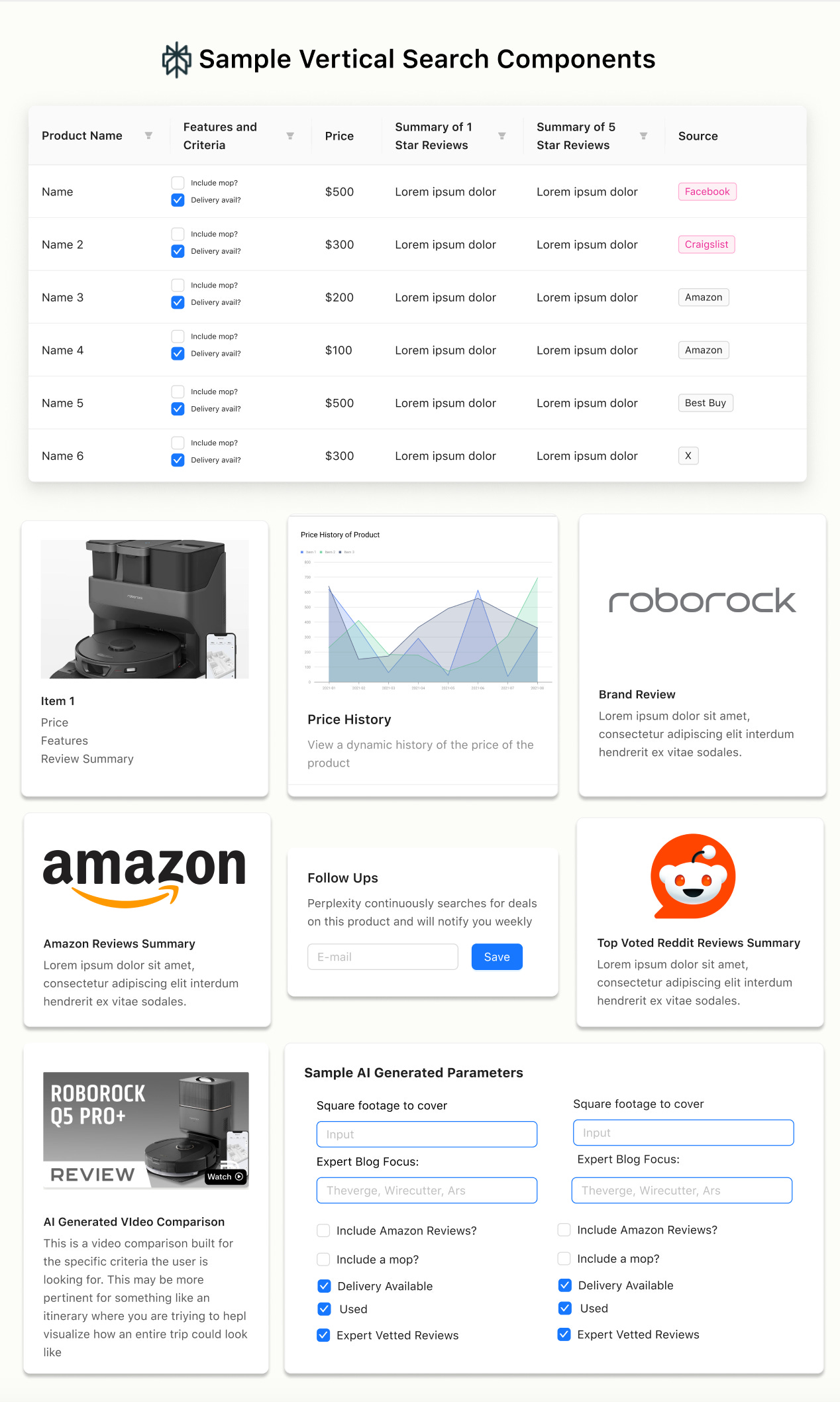
There is an enormous opportunity for Perplexity to build AI-native experiences in specific verticals. Perplexity could develop a series of modular, AI-enabled components focusing on the most crucial parameters, and dynamically embed them based on the user's search context. These components could include displaying price history, review summaries, value proposition comparisons, press release summaries, the latest financial information, and AI generated visual comparisons, among many others. To better understand the potential applications of this approach, let's explore some use cases:
Itinerary Booking: When a user is deliberating over creating an itinerary, they may want an aggregation of options from a multiple different search engines (flights, hotels, restaurants, etc). Beyond a simple aggregation, there are specific criteria that likely matter to them: comparable prices, price history, points deals, Reddit reviews, curation for type of travel, preference of activities, etc). They may even want an AI generated video comparisons of two different itineraries to better understand what it may feel like.
Real Estate Search: Let’s take the real estate search example. Could perplexity AI integrate SOTA vision capabilities and dynamic toggles to display a curated list of homes that match the user's specific criteria? Imagine searching for a specific kind of house in a region with extreme granularity — not just the type of home or square footage but details like: granite countertops, 10-foot ceilings, balcony, view of city, open concept living room, etc.
Shopping: Take shopping for a robot vacuum. Perplexity should ask the user for the attributes they care about (e.g. used vs. new, mopping capabilities, square footage, suction power, brand preference, etc). It should be able to search multiple websites, forums and provide a summary of the best and worst reviews. It should be able to pull price history from sites like Camelcamelcamel. It should be able to look into third party marketplaces to show users the different options across used and new products. It should be able to package this all up in a UI that’s highly intuitive for user to be able to engage with.
Here’s a sample set of components one could imagine for a typical shopping search: Note: these are simply components to be embedded into carousels, tables, and other UI elements depending on the context of the query, not displayed in this manner
Natively building deeper vertical search and partnering with external providers leads us into the second tenet of building the second generation answer engine:
Integrating With Third-Party Providers:
Legacy marketplaces and vertical search engines have spent years developing a solution to help users navigate towards a curated answer. In many cases, they’ve built access to proprietary data unavailable elsewhere (e.g., Course Hero, ResearchGate, Amazon). In other cases, they’ve created flourishing communities of members who actively post, rate, and provide their perspectives on the products and services (Yelp, Maps, SlickDeals). They’ve also built a plethora of pre-canned filters to help users find a curated set of relevant results. Perplexity has the opportunity to partner with a number of these, aggregate results and provide an AI native solution on their platform. For example, take this query about “benefits of taking l-theanine”. This user might be looking for specific excerpts from scholarly articles. Imagine a toggle to enable access to scholarly sources like Elicit, Academia.Edu, ResearchGate Let’s take a look at both responses:
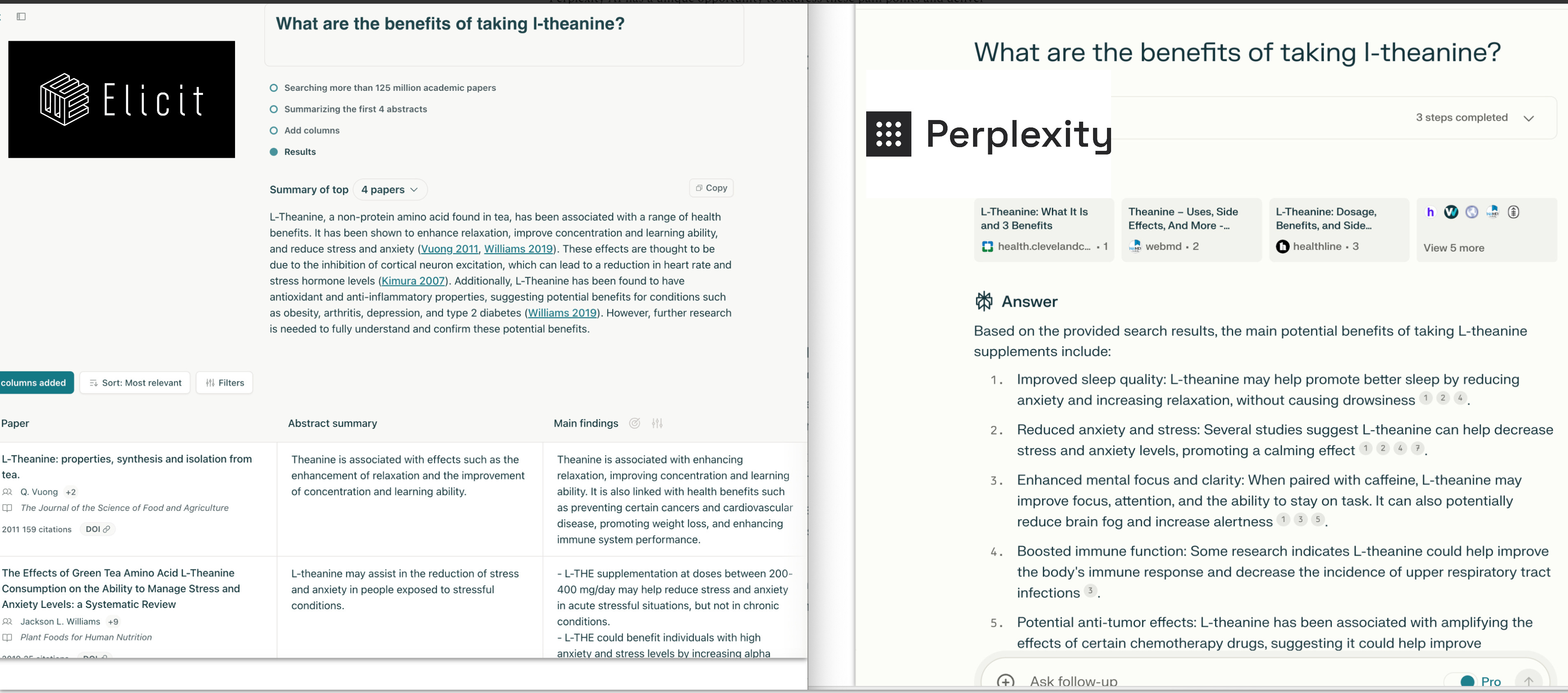
Could Perplexity partner with companies like Elicit, Researchgate, Academia.edu that have access to papers Perplexity doesn’t and build a better AI-native search experience on the results of Perplexity? See a sample image below of what an AI native partnership could look like.
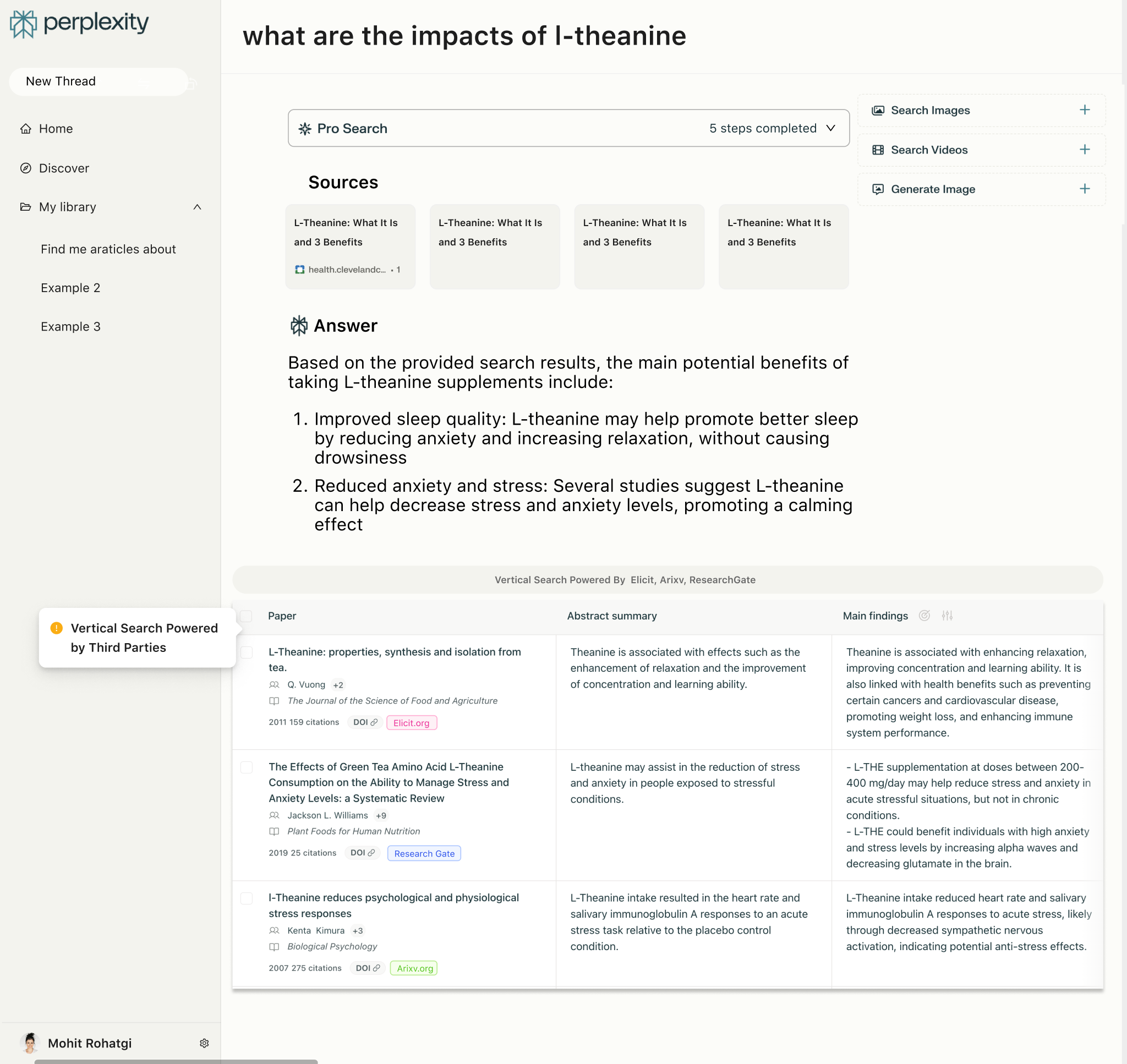
In this example, a user seamlessly gets scholarly results with AI summaries and the extraction of key findings to determine their perspective. Imagine that the columns are modular here (as per Elicit) — if a user wanted contradictory information or information focused on a specific facet of l-theanine, they could add that as an option. Lastly, the embedded follow-up option in Perplexity is critical to continuing to refine the vertical results.
Let’s extend this to other verticals: could Perplexity partner with DoorDash and Uber Eats to get an aggregated view of all results with menus, AI-summarized reviews so users can easily compare across multiple engines? Could Perplexity partner with Zillow, Apartment List, LeaseBreak to get listings, pictures, price history charts, and comparables to other rentals? Partnership as a term is held loosely here — in some cases, deep, structured relationships may not be necessary to aggregate results. Replicating this across all their top verticals would help position Perplexity AI as the ultimate destination for all search needs.
Dynamic conversations:
Perplexity should become the AI expert that you engage with on any matter at hand.
Imagine having an AI travel agent, a stylist, a personal shopper, a tutor at your fingertips. This paradigm can be replicated across every vertical and facet of a users query.
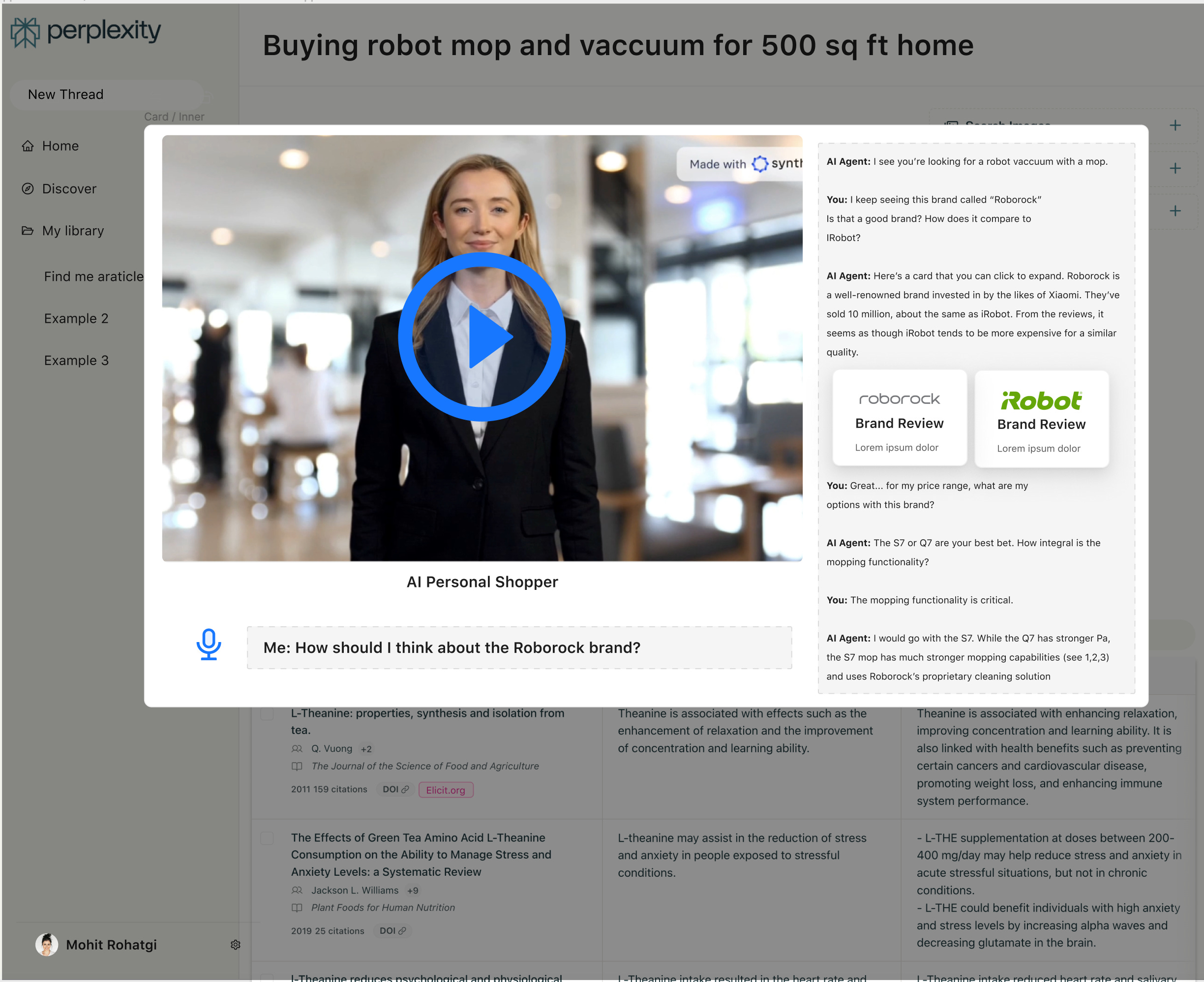
Beyond verticalizing, there should be a stronger emphasis on the conversational interface. Ultimately, when you picture engaging with a stylist, travel agent, shopper, or any “expert” in the analog world, it rarely is a one time interaction. Often, there is a back and forth to drill down on exactly what you’re looking for — whether it’s a specific type of itinerary, an article of clothing, to understanding a business concept. You may want different options for each, to see what resonates most. Imagine a video comparison that your expert provides you of two different itineraries curated to you so you can decide the optimal travel solution. While perplexity has “follow-up” and pro-search features, there are mechanisms to amplify the conversational experience to make it feel like the user is truly engaging with an AI expert. Whether it’s opening up more modalities (voice/video), embedding vertical search cards, or generating AI enabled visual comparisons, there are many levers to explore in this realm.
Let’s use a shopping example, say, for a robot vacuum. Often times, a user doesn’t know what parameters they're looking for in the first query. What brand do they want? What item from a specific brand is best for mopping? What do the top-voted comments on Reddit say? After the user gets this information, they may have additional questions. An AI expert can help you get to the ground truth about what you’re looking for. Whether it’s just with voice or a video avatar, this builds a truly immersive experience around search. See the example below:
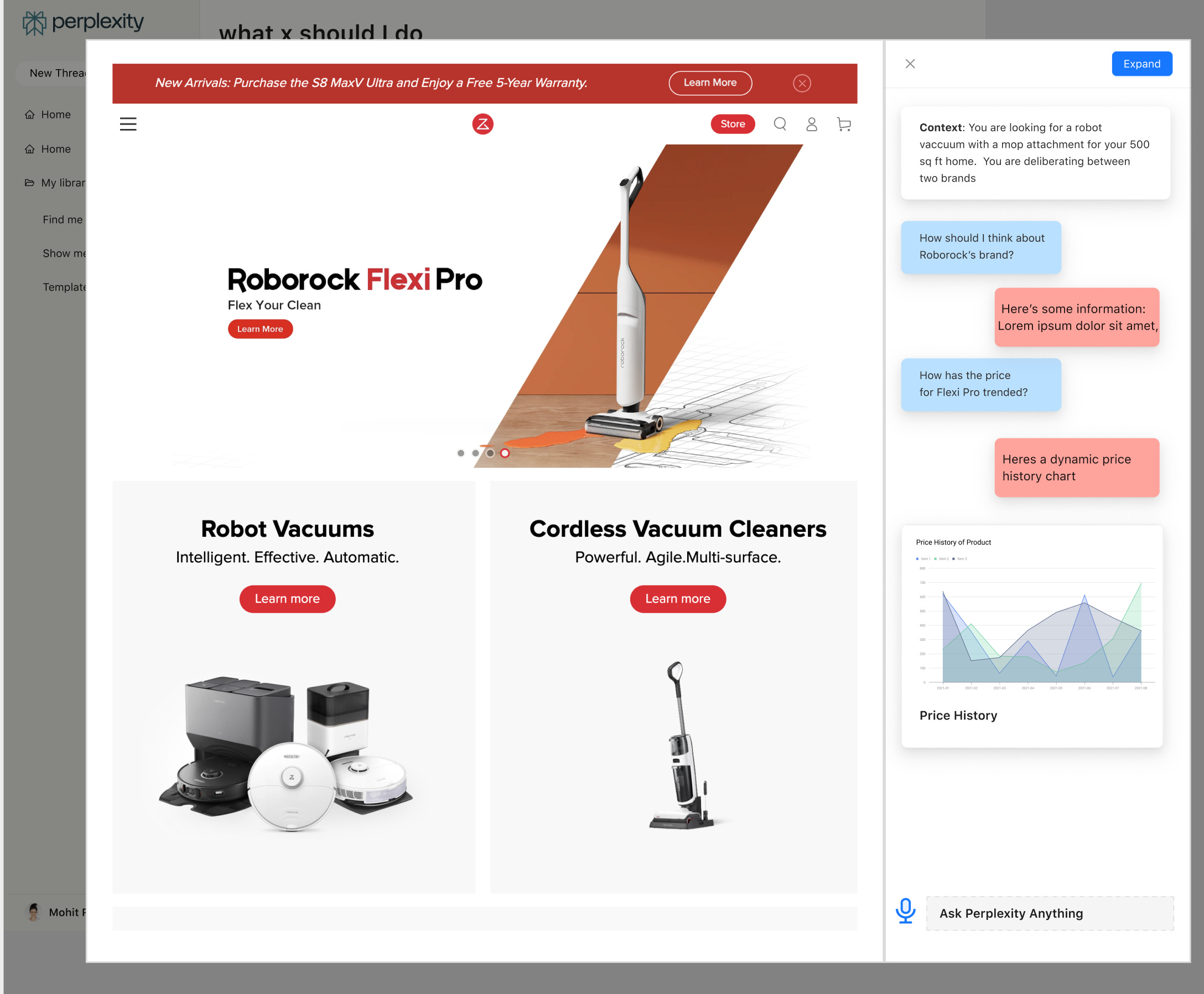
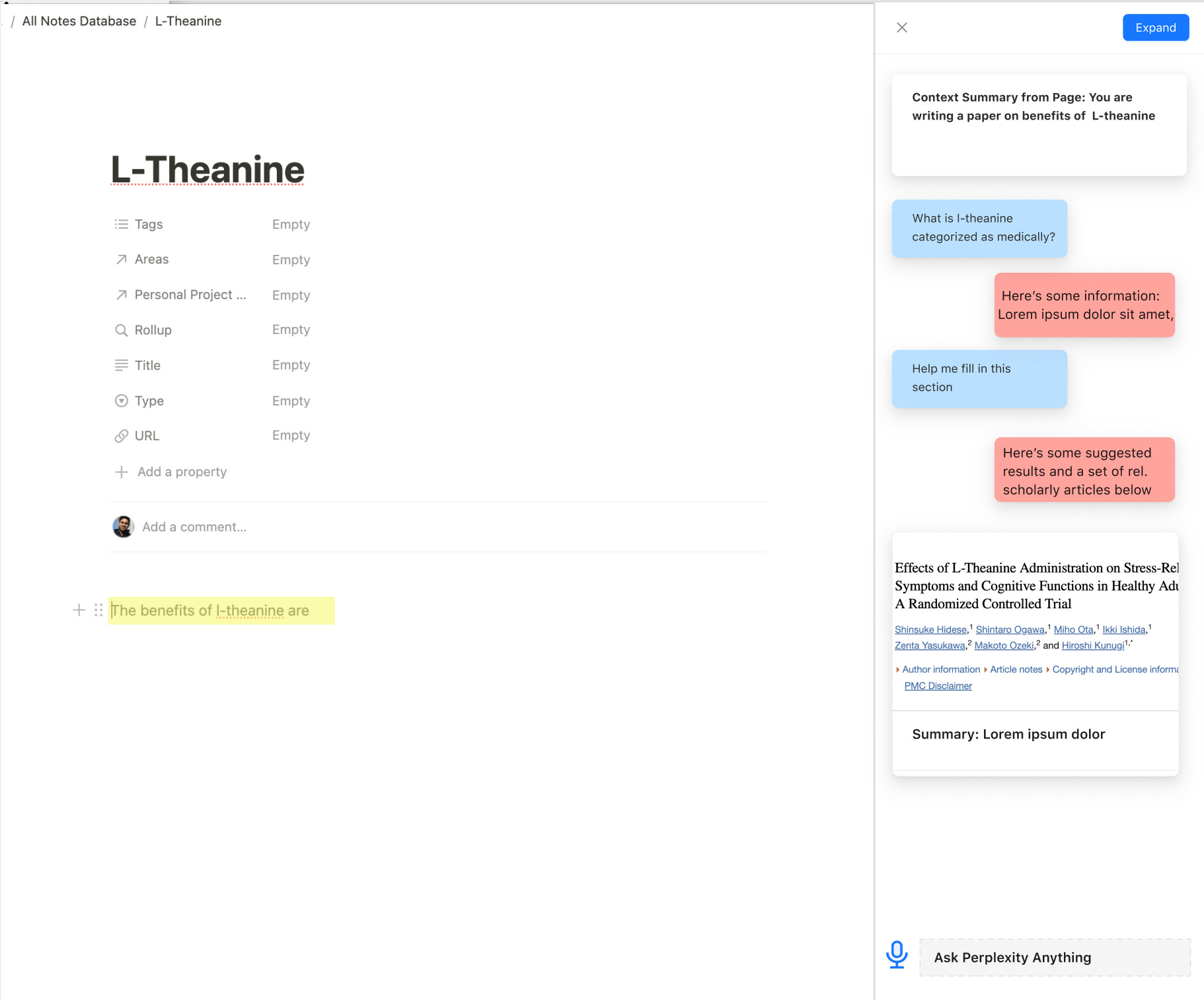
A more nuanced lever to make the experience more dynamic is to embed is an AI-supported sidebar every time a user clicks a link. The sidebar would have an AI chat interface where a user can ask a question in natural language, and surface the aforementioned cards where contextually relevant. Most importantly, it leverages the context of the query (and follow-ups) so it can build more curated answers. If a user doesn’t want to use the perplexity features, they can easily click expand to open the page.
Curation
Perplexity has a “profile” section where a user can input context on who they are for personalized search results. Perplexity has the ability to amplify this by ingesting an incredulous amount of data on a user — whether it’s through a user’s Yelp reviews, Facebook, Instagram, Linkedin, or a beautifully architected onboarding flow that extracts the key pieces of information on a user. With a desktop app (see ubiquity below), Perplexity can even ingest the context of the screen that the user is on to deliver stronger results. Let’s view some examples of what this could look like:
If a user is looking for a restaurant reservation, Perplexity could have ingested context on their preferences, their prior reservations, and reviews to deliver truly personalized results
If a user is looking for itinerary suggestions for them and their partner, Perplexity could have ingested beforehand (or asked in context via the AI conversational experience above) preferences for the user and their partner to curate the best results from the get-go.
If a user is writing a paper on a topic, and Perplexity has access to the screen that the user is on, it can deliver a curated set of results and suggestions to the topics at hand.
Again, the optimal solution for any query for a user is one that is hyper-personalized to them, their needs, and their preferences while limiting the manual input required to do so.
Ubiquity
Perplexity's powerful engine should be accessible to every user, regardless of where they are in their desktop environment. The ability to access relevant research, summaries, and information based on the user's current context, without forcing them to navigate away from their primary focus, is revolutionary in information retrieval. Traditionally, this process often involves juggling multiple windows and tabs, followed by the arduous task of manually collating the results.
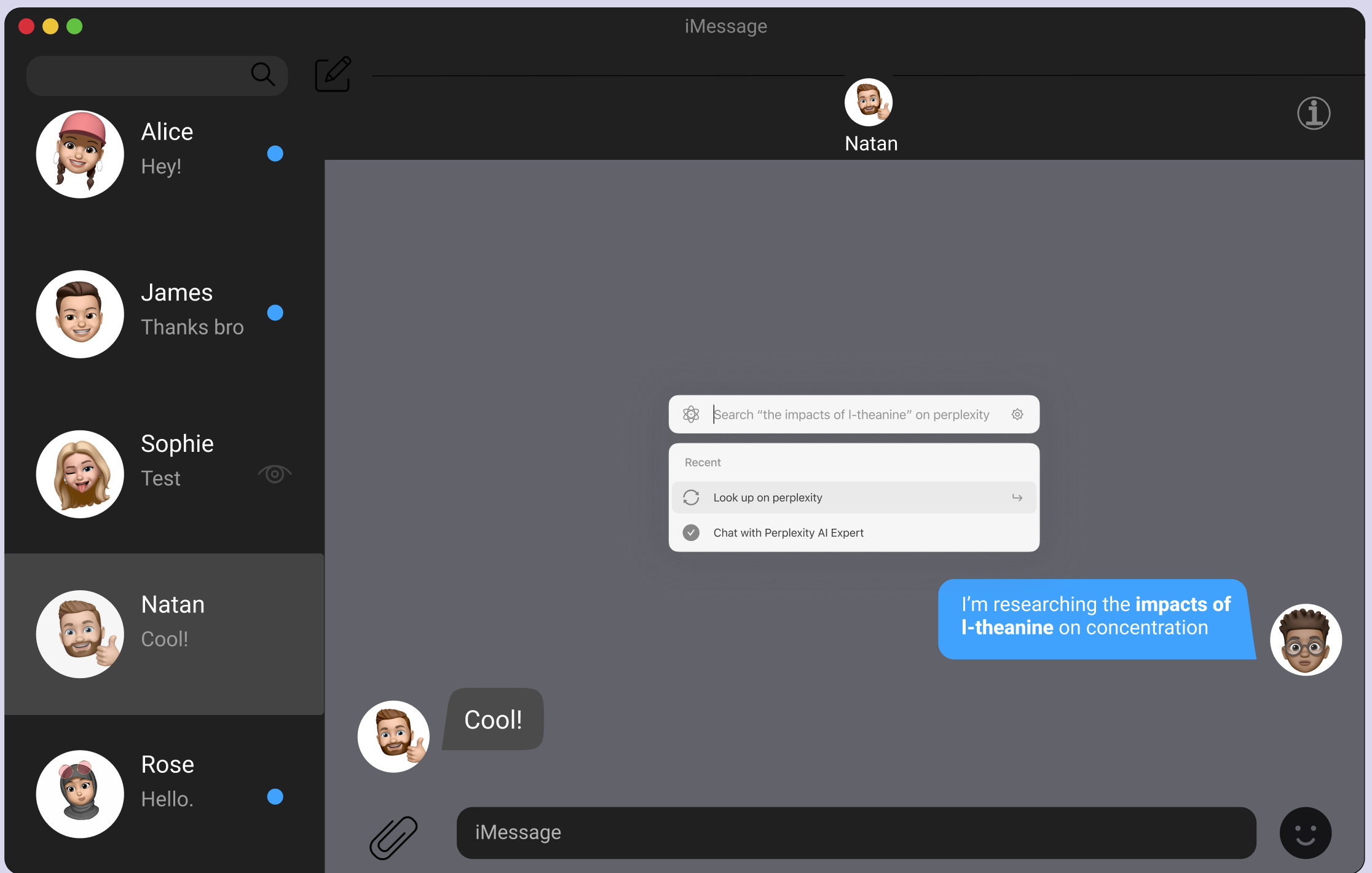
For example, if a user is looking at their texts and is looking to understand something more deeply, they should be able to invoke Perplexity and have a quick glance of the results. If a user is drafting a presentation and needs to research quotes or images for a presentation, they should be able to invoke Perplexity from the tool they’re on. If a user is in a word document and want to research/find examples or counterpoints for something, they should be able to invoke perplexity and even “inject” information into the document. Again, the optimal solution for a user here isn’t to open a web browser, add the context of the document/presentation/message and type in a query, but rather to have this omnipresent agent that magically understands the context and can provides a relevant result in a few seconds. This should invoke a similar perplexity sidebar that can be expanded — with both the ability to ask any question in natural language but also recommendations on information that may be useful.
Bonuses:
Business Model Future:
The most critical question is how does Perplexity monetize (beyond pro subscriptions)? Let’s look at a scenario to explore this question.
Perplexity scrapes or plug-into a users Linkedin, Spotify, Facebook, Instagram, Twitter etc to understand more about their preferences, what they cared about and who they were
Perplexity could use that in conjunction with the search history to build not 10, but 1 or 2 highly personalized ads per page that seamlessly fit into the right rail under the images
Perplexity could dynamically have the copy, the images and even videos generated via AI for the context of the user
The hyper-personalization would drive an order of magnitude stronger CPMs, CTRs and conversions (?)
Given the conversational nature of the platform, would this enable Perplexity to display more ads in aggregate (e.g. one ad per query and follow-up)